
Section 6
Agents and Cognitive Orchestration
What remains for the Agent once judgments are named and procedures are packaged, and how repeated trajectories compress into competence.
9 min read
A Cognitive Unit owns a judgment. An Agent owns progress toward a goal. This distinction is simple, but it separates two fundamentally different architectural responsibilities.
A Cognitive Unit is bounded around a decision. Its job is to accept relevant inputs, perform one coherent cognitive responsibility, and return an evaluable result. An Agent operates at a different level. It may need to decide which judgments are required, which tools should be used, what information is still missing, whether an intermediate result is sufficient, and what should happen next. Its responsibility is not a single conclusion but the controlled progression of work toward an outcome.
An Agent may therefore own a goal, working state, applicable policies, available authority, accessible Cognitive Units, tools, context, stopping conditions, and escalation conditions. These elements define the space within which it is allowed to operate. A customer-recovery Agent, for example, may be responsible for resolving a service complaint. To do so, it might retrieve booking information, ask a Cognitive Unit to interpret the complaint, invoke another to assess severity, calculate compensation using deterministic code, consult policy, determine whether the proposed remedy falls within its authority, and either execute the action or escalate the case to a human.
The Agent does not need to perform each judgment itself. Its distinctive responsibility is orchestration.
This orchestration is often described through an agent loop. Conceptually, an Agent may plan, act, observe, review, revise, and repeat until it reaches a stopping condition. It may begin with an initial interpretation of the goal, select an action, inspect the result, reconsider its state, and decide whether another step is necessary. This loop captures something important about goal-directed cognitive behaviour: the path to completion does not always need to be specified in advance.
The loop should not, however, be mistaken for a mandatory implementation algorithm. Some Agents may require extensive planning and revision. Others may follow a relatively stable sequence with only occasional branching. Some may plan explicitly, while others make smaller local decisions after each observation. A mature Agent may even bypass most deliberation for situations it has encountered many times before. What defines the Agent is not a particular loop structure, but its ownership of the evolving trajectory toward a goal.
This distinction also clarifies the relationship between orchestration and intelligence. Current agent architectures often place large amounts of cognitive responsibility inside a general-purpose reasoning loop. The Agent receives a goal, reasons about the problem, chooses tools, interprets results, evaluates its own progress, and produces an outcome. This can be powerful, particularly for novel tasks. It can also become difficult to inspect, expensive to operate, and hard to improve systematically when recurring judgments remain buried inside the loop.
Thoughtware therefore favours a different architectural tendency: Agents should orchestrate cognition rather than absorb every cognitive responsibility into an opaque general-purpose loop.
When a recurring decision has a stable meaning, it can often be extracted into a Cognitive Unit. Instead of repeatedly reasoning from first principles about whether an invoice discrepancy is material, an Agent can invoke a capability whose responsibility is precisely to make that judgment. Instead of reinterpreting compliance policy inside every trajectory, it can call an evaluated policy-assessment unit. The Agent remains responsible for deciding when those capabilities are needed and how their results affect progress, but the judgments themselves gain locality.
This separation improves reuse and evaluation, but it also has an economic consequence. Agent loops are expensive. Every additional cycle may require model inference, retrieval, tool execution, intermediate state, and further evaluation. More importantly, an open-ended loop introduces variability in both cost and behaviour. For unfamiliar, high-ambiguity problems, that flexibility may be justified. For familiar situations, repeatedly reconstructing the same reasoning is wasteful.
A mature Thoughtware system should therefore not reason endlessly about situations it already knows how to handle.
Repeated successful trajectories can gradually be compressed. A judgment discovered repeatedly inside an Agent may become a reusable Cognitive Unit. A stable sequence may become a deterministic fast path. A recurring approach may become a learned strategy. Patterns drawn from accumulated experience may become explicit expertise that shapes future decisions before an expensive search process begins.
This creates a natural progression from deliberation to competence. Early in the life of a system, an Agent may need to explore several possibilities, inspect intermediate results, recover from errors, and repeatedly revise its plan. As the system gains reliable capabilities and recognises familiar situations, fewer decisions need to be rediscovered inside the loop. The trajectory becomes shorter, cheaper, and more predictable.
Crucially, compression should not eliminate the slower path. Familiarity can be mistaken, context can change, and apparently routine cases can contain novel conditions. A capable architecture therefore preserves the ability to return to deeper reasoning when confidence is insufficient or when a known strategy no longer fits. Fast paths represent accumulated competence, not permanent certainty.
This also explains why Agents and Cognitive Units should remain distinct even when their boundaries sometimes appear blurred. A sufficiently complex CU may contain internal reasoning steps. An Agent may make small local decisions that do not deserve separate components. The distinction is not based on the number of model calls or whether a loop exists internally. It is based on responsibility. A Cognitive Unit is accountable for the quality of a particular judgment. An Agent is accountable for moving a larger goal toward completion.
What Remains for the Agent
Once judgments can be named and procedures can be packaged, the Agent’s repertoire becomes easier to describe. A Cognitive Unit makes a particular judgment. A Skill performs a known capability. Deterministic code or a tool performs a specified operation. What remains for the Agent’s own reasoning is the decision about which of these should happen next.
This makes the boundary between a Skill and an Agent unusually clear. In a Skill, the answers may vary, but the broad shape of the work does not. In an Agent, evidence encountered while pursuing the goal can change the shape of the work itself. A Skill may branch, and it may branch on cognitive grounds, without becoming an Agent; what matters is whether the available routes are bounded by the capability it declares. Agency begins when runtime evidence determines which capability to undertake next, whether to open a new line of investigation, whether to abandon a route already taken, and whether the goal has been sufficiently achieved.
There is also a practical argument for Skills that has nothing to do with taxonomy.
An Agent presented with eighty-seven Cognitive Units, thirty-four functions, a dozen queries and half a dozen integrations must reason about implementation detail before it can reason about the problem. If those operations already form stable and meaningful procedures — verify invoice, collect missing evidence, prepare approval package, apply approved adjustment — the Agent can reason over domain capabilities instead. The reasoning surface becomes smaller, trajectories become shorter, and the resulting behaviour becomes easier to inspect.
An Agent should not be made to rediscover work the system already knows how to perform.
The architectural value of the Agent therefore lies in controlled composition. It brings together cognitive capabilities, deterministic operations, tools, knowledge, state, and authority into a goal-directed process while preserving the boundaries of responsibilities that deserve to remain explicit.
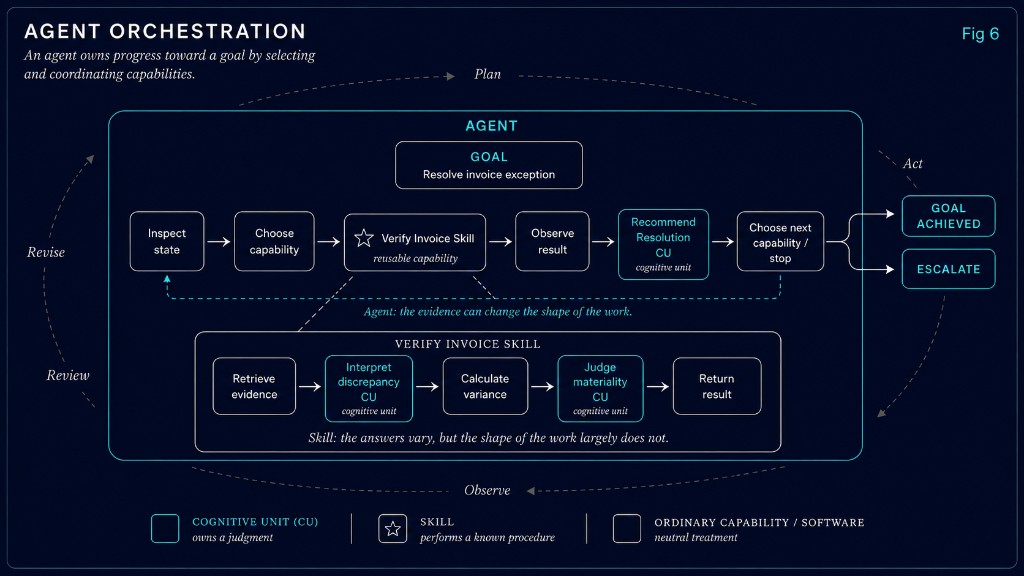
Agents should spend their uncertainty where uncertainty remains. Known judgments should be delegated to Cognitive Units, known procedures should be delegated to Skills, and the Agent should own the evolving trajectory toward the goal.
As Thoughtware matures, this orchestration can itself become more capable.
Agents can accumulate experience about which strategies work, recognise recurring situations earlier, and rely increasingly on reusable expertise. The next question is therefore how a system distinguishes what it knows now from what it has learned before, and how repeated experience can alter future judgment.